Active Research Project

Mycoremediation
on the Rouge

Using the biochemical properties of native fungi to extract contaminants from the water and sediment of the Oxbow and Suwanee Lagoon.

The Henry Ford Field Site Partner
Rouge River Watershed Dearborn, Michigan
Americana Foundation $25K Grant, 2025
Scroll
Mycoremediation is the use of fungi to decontaminate a polluted environment.
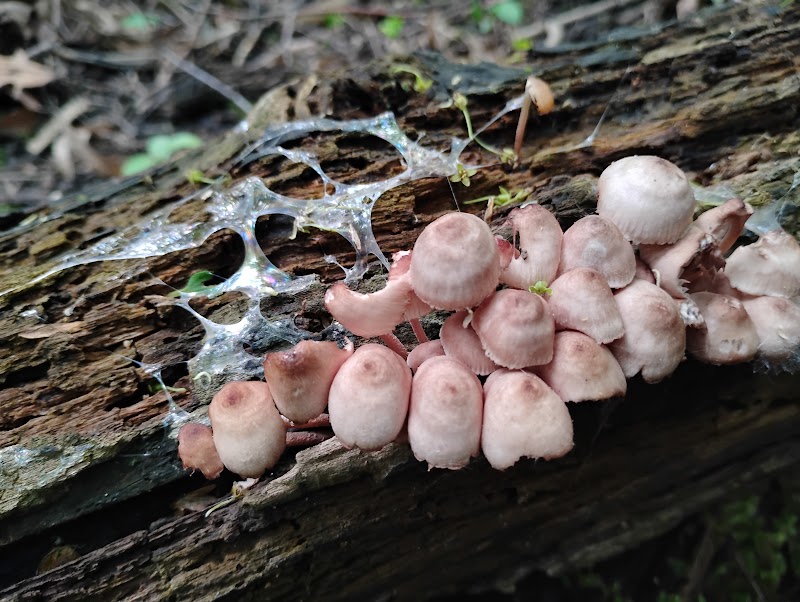
Why fungi?

Fungi are extraordinary biochemical engineers. Their mycelial networks — the thread-like structures that spread through soil and water — produce enzymes capable of breaking down complex organic pollutants and bioaccumulating heavy metals. What makes them compelling for remediation is that this is something fungi already do, as part of ordinary life in a healthy ecosystem.

Mycoremediation is a developing field, and field-scale demonstration data is exactly what's needed to move it from promising to proven. That's what this project is generating.

The Oxbow &
Suwanee Lagoon

The Oxbow and Suwanee Lagoon sit on the grounds of The Henry Ford in Dearborn, Michigan, directly on the Rouge River — one of the most historically industrialized waterways in the Great Lakes region. This location makes it an ideal pilot site: real contamination, real water, real conditions.

In partnership with The Henry Ford, and with support from a $25,000 grant awarded by the Americana Foundation to The Henry Ford (the Edison Institute), The Mushroom Conservatory is conducting the first rigorous, data-driven mycoremediation field research program on this watershed.

80+
Native fungal species
catalogued at the site
$25K
Americana Foundation
grant to The Henry Ford
4
Contaminant classes
under active testing

The Rouge River has borne a century of industrial activity. Remediation here isn't a contained laboratory exercise — it's a direct confrontation with legacy contamination in a living ecosystem. Methods that prove effective here have immediate implications for waterways across the broader Great Lakes region.

Oxbow & Suwanee Lagoon — field site
Native species survey
Filter installation

Living water filters

After cataloguing over 80 native species present in the lagoon ecosystem, we identified the best-suited candidates for active remediation. We're using those species to build living water filters — structures of fungi, wood chips, and straw — installed directly in the water, so that contamination is addressed as it flows through.

Using native species matters. It reduces ecological risk and leverages organisms already adapted to this specific environment and its particular contaminant profile.

  • 1

    Site Survey & Species Inventory

    Comprehensive cataloguing of native fungi at the Oxbow and Suwanee Lagoon, including DNA analysis and field observation. Baseline water and soil quality documented.

  • 2

    Species Selection

    Best-suited candidates identified based on their biochemical properties and compatibility with the observed contaminant profile at the site.

  • 3

    Filter Construction & Installation

    Living filters — fungi, wood chips, straw — built and installed directly in the water at selected points along the lagoon.

  • 4

    Before/After Water Testing

    Water sampled upstream and downstream to generate rigorous data on filtration effectiveness across four contaminant classes.

What we're testing for

Current scope

  • PFAS (per- and polyfluoroalkyl substances) — "forever chemicals" that persist indefinitely in the environment and accumulate in living tissue
  • Organic contaminants — a broad class of carbon-based pollutants from agricultural and industrial sources

With additional funding

  • PAHs (polycyclic aromatic hydrocarbons) — byproducts of combustion and industrial processes, common in legacy industrial sites
  • Heavy metals — including lead, mercury, and cadmium from decades of industrial activity along the Rouge

Where we are

01
Complete

Site Survey & Fungal Inventory

Comprehensive survey of the Oxbow and Suwanee Lagoon. Over 80 native species catalogued. Baseline soil and water quality documented.

02
Complete

Mycological Assessment

Ecological roles and health of identified species assessed. Remediation candidates selected based on biochemical fit and site conditions.

03
Active

Filter System Development & Lab Prep

Building and iterating on the filtration systems. Preparing for third-party lab validation on PFAS and organic contaminant panels. Heavy metals and PAHs in scope with additional funding.

04
Upcoming

In-Water Pilot & Field Testing

Filters installed in the Oxbow and Suwanee Lagoon. Water sampled upstream and downstream to generate before/after data across contaminant panels.

05
Upcoming

Analysis & Scale-Up

Evaluate pilot data, refine methods, and develop protocols for scaling effective approaches across the broader Rouge River watershed.

Working together

The Henry Ford
Field Site & Institutional Partner

The Henry Ford hosts the research at the Oxbow and Suwanee Lagoon, providing access to a field site with both historical significance and direct ecological relevance — on the banks of the Rouge River itself. Their institutional support makes it possible to conduct this work in the right place, not just a convenient one.

The Americana Foundation
Grant Funder — $25,000

The Americana Foundation awarded a $25,000 grant to The Henry Ford (the Edison Institute) to fund the foundational field research behind this project: the fungal survey, field testing, and filtration system prototype development. That investment is what gave this work its scientific legs.

Friends of the Rouge
Watershed Supporter

Friends of the Rouge has been a genuine supporter of this project from early on — making key introductions and providing a letter of support that helped open doors. Their deep knowledge of the Rouge watershed and the people who steward it has been invaluable context for this work.

The Mushroom Conservatory
Lead Research Organization

Founded by Erin Hamilton, The Mushroom Conservatory brings years of hands-on cultivation experience, mycological knowledge, and a track record of collaborative research with universities, community programs, and conservation organizations. This project is the most ambitious expression of that work to date.

How to help

A lot of people ask how they can support this project, which is genuinely appreciated — and deserves a clear answer. Direct volunteer work at the field site isn't feasible right now; this stage of the research requires specialized protocols and careful documentation. But there are three things that actually move it forward.

Fund the research

Water testing, lab analysis, equipment, and field time all have real costs. Grants cover the foundation; direct contributions fill the gaps and make it possible to run more samples, test more variables, and build a stronger data set. Everything goes directly into the science.

Connect us

If you're an environmental scientist, mycologist, toxicologist, or water quality researcher — or you know someone who is, or have connections to institutions or grant-making organizations with interest in environmental restoration — we'd genuinely like to hear from you. The right introduction can open doors that funding alone can't.

Spread the word

This work matters beyond the Rouge. If mycoremediation proves effective here, the implications extend across the Great Lakes region and beyond. The larger the network that knows this research exists, the larger the pool of potential collaborators, funders, and partners. Sharing it costs nothing and compounds.

Follow the research

Get occasional updates on field work, lab results, and what we're learning. No noise — just the work.

This opens your email app with a pre-filled signup request.